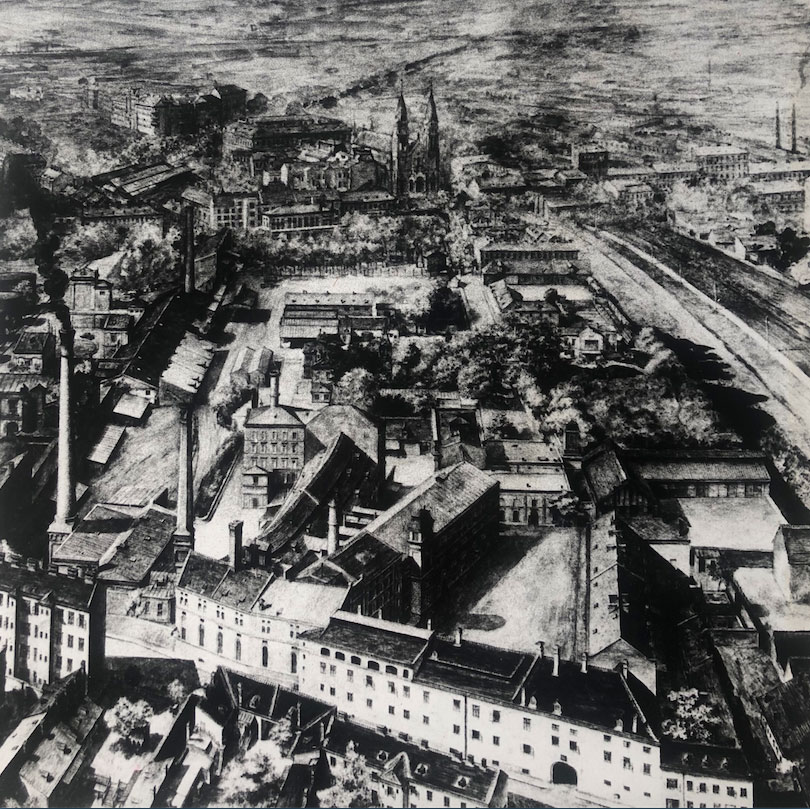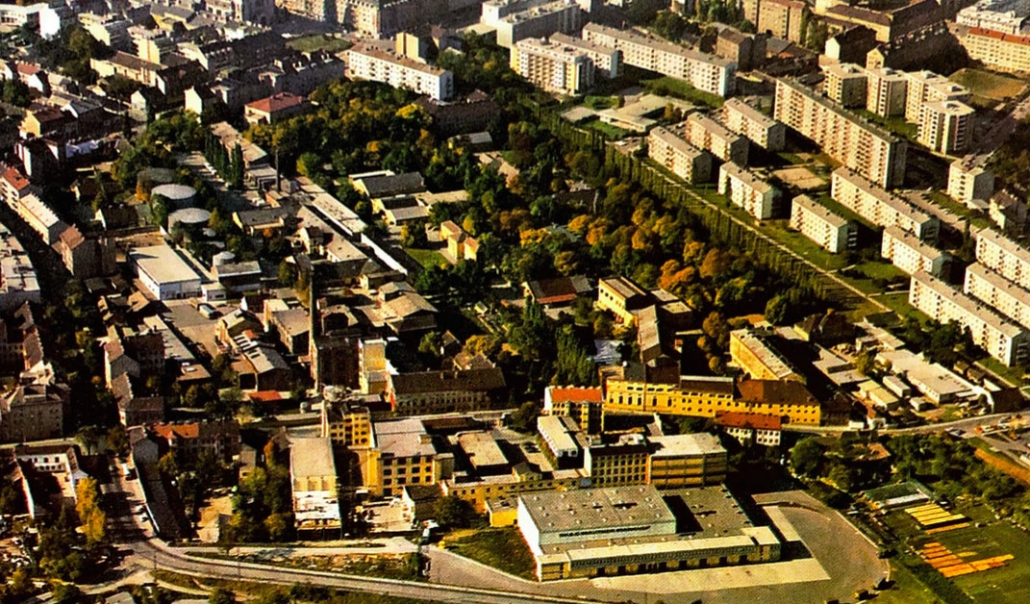
There is often confusion about what ‘Simmering’ meant economically and geographically in connection with Mautner Markhof. Below is an overview in chronological order:
In 1783, the Himmelpfort monastery, which had dominion over Simmering and the Thurnhof, including a brewery, was abolished. This was the area between today’s Dittmanngasse, Krausegasse, Dorfgasse (now Mautner-Markhof-Gasse) and Simmeringer Hauptstraße. In 1802, Johann Georg Dittmann bought the Thurnhof together with the brewery at auction, but sold the property to master brewer Georg Meichl in 1822, who in turn ran it until 1834.
In 1913, the legendary merger of Ad. Ign. Mautner Ritter von Markhof & Sohn, Brauerei St. Marx AG and Brauerei Simmering Th. & G. Meichl AG, which led to the founding of Vereinigte Brauereien Schwechat, St. Marx, Simmering – Dreher, Mautner, Meichl Aktiengesellschaft. The beer production of St. Marx (Mautner Markhof) and Simmering (Meichl) moved to Schwechat and the yeast and spirit production of St. Marx moved to Meichl’s premises in Simmering and was merged under the Vereinigte Mautner Markhof’sche Preßhefefabriken. Carl Ferdinand’s son Victor had sold the yeast and spirit production to Theodor I and Georg II Anton at the same time. The company was legally divided into two companies: Vereinigte Mautner’sche Preßhefe Fabriken Ges.m.b.H. (for yeast and spirits, including the production facility in Floridsdorf, which was shut down in the 1930s) and Th & G Mautner Ritter von Markhof (for mustard, vinegar and spirits). Although outwardly a single property in the hands of the family, it was legally divided between two companies. On the one hand to the Schwechat Brewery (the area from the current Jufa Hotel to the geriatric centre) and on the other hand to Vereinigte Mautner’sche Preßhefe Fabriken Ges.m.b.H. (the area beyond the Jufa Hotel to Krausegasse/Mautner Markhof Gasse).
In the 1930s, Th & G Mautner Ritter von Markhof, which produced mustard, vinegar, spirits and liqueurs, moved to a newly built site to the east of what is now Mautner-Markhof-Gasse. This site still exists today and was sold to Develey in 2004. All that remains – on the site that is described below and where some of the family lived and grew up – is the yeast production and the Schwechat brewery’s beer depot and materials warehouse. The materials warehouse was actually a carpentry workshop that produced all the dispensing systems, ice boxes, washing-up systems, beer taps – simply everything a publican needed. The background to this was that they endeavoured to make everything available to the pubs, the particularly important customers for the beer, in order to be able to contractually ensure that no competing beer could be served (non-competition clause). In some cases, the breweries even went so far as to have themselves entered in the land register of the pubs in order to exclude any competition.

Memories of Theodor Heinrich Mautner Markhof, May 2025
The factories remained self-sufficient until almost twenty years after the end of the war, producing almost everything themselves – even their production facilities were built and maintained by them. This also included an in-house planning office called Vogelbusch, which operated under its own legal entity and also worked for external companies. There was a joinery, locksmith’s shop, cooperage, a car and lorry workshop, refrigerator production, painting business, electrical installation department, etc. We even had our own gardener’s workshop. We even had our own nursery, which supplied the company canteen with fruit and vegetables. The work processes were very harmonious and peaceful, e.g. the metalworkers even had time to spend with us children and, after much pleading and begging, forged slingshots out of iron. Even an amateur-built aeroplane (without an engine), covered with fabric, could be made in the factory for hobby purposes. The factory siren sounded loudly at seven in the morning, at noon and sometime in the afternoon. This meant that everyone on site knew the time for shift changes or the start of work, lunch and the end of the day. In fact, where does the greeting ‘Mahlzeit’ come from? It comes from the time when workers didn’t have watches, or no longer had watches (as they had been taken from them by the Allies after the Second World War). So, as a precautionary measure, if someone didn’t hear the siren, they would shout ‘Mahlzeit’ (‘let’s go eat’). This, in turn, gave rise to the greeting that has survived to this day, but was frowned upon in so-called aristocratic circles at the time. We were taught to actively greet people from an early age. We were always supposed to greet people first, no matter who they were! Of course, this had a positive effect on the workers and wherever we turned up, they treated us much more kindly. It also had the side effect that they let us into the buildings because they were proud to be able to explain their work to us. The yeast production wasn’t actually very exciting, and the packaging didn’t interest us much either, but the steam house, unfortunately taboo for us children, was incredibly fascinating. In this energy centre, steam was first generated from coal, later from heavy oil and from the 1970s also from gas, which was used both for yeast production and for heating, as well as for the electricity produced at the time. Two gigantic flywheels, perhaps eight metres high, operated the generators by means of a leather conveyor belt, accompanied by an indescribable noise. Even the floor shook and vibrated. My stories take us back to the year 1962.
Even with us children, certain prestige pressures emerged back then: ‘Look, I’ll show you my playground, it’s much better than yours.’ Who am I talking about when I say us? Well, my cousin Quintus and cousin Carmen, Uncle Georg’s children, lived behind the wall, and the children of so-called key workers or technicians, such as the electrician’s son, lived in official flats. At first I was able to lure my cousins and the others over to my side, but the area was far too small and the other side, the yeast factory at the time, was much bigger and therefore a far more interesting playground. Today, it would be unimaginable for six-year-old children to be allowed to run around freely in a factory. But during this time, our instincts had warned us where it would be too dangerous or in which places we had to be particularly careful. The workers usually chased us away anyway if they thought we were in their way. At the beginning, we only spent time outdoors and didn’t dare go into the buildings on our own. We also learnt to drive a carriage. The horse was called ‘Susi’, a very large, heavy animal that only walked at a walking pace and, with her coachman, Schurli Blemenschütz (also a wrestling legend at Vienna’s Heumarkt), only ever had to make simple internal journeys. There was still a stable in the factory itself, where even a few pigs were kept. The former coal storage area, which had been turned into a scrap yard after the switch from coal to heavy oil, served as our ‘battlefield’. There was plenty of cover between the old tanks, machines and scrap parts to play cops and robbers, protected by old firefighter helmets from the monarchy (which would be worth collecting today). This place also bordered another house that no longer belonged to the factory. When they shouted at us from there not to make such a racket, we shot out all the windows with metal rods (approx. 40 – 45 millimetres long) that were lying around. Well, that was a big mistake, because although we vehemently denied that we had belonged to the team in question that day, we were banned from entering the pitch. The fact that the police were then called to Uncle Georg J. E. was also not very amusing for us. I also got a big reprimand from my grandfather, who was still running the factory at the time. As he had got everything through the war well, his cousin Georg III ‘Buwa’ then left him not only the sole management of the Schwechat brewery, but also essentially that of the Simmering operations. It was only much later that my father succeeded him in Schwechat and Georg J. E. in Simmering at the end of the 1960s. Buwa himself had been content with both supervisory board positions.
The fact that we had no business in the factory made it all the more interesting for us. From this point on, it was therefore particularly important to be able to move from one place to another within the site without being detected. In our search for such paths, we came across the cellars (built by Dittmann and Meichl, possibly also by their previous owner, the Himmelpfort monastery). The location for the cellars was not chosen without reason at the time, as geologically speaking the soil there is clayey and covered with a layer of sand. This was due to the fact that the area used to be a branch of the Danube and the cellars were built on its embankment. Only places with loamy soil were chosen so that the excavated material was immediately available for the production of bricks, which in turn could be used for the construction of the cellar. Later, the higher quality clay of the Drasche family from the Laaer and Wiener Berg was used for bricks. The cellars themselves were so-called wine or ice cellars. The wine cellars went less deep into the ground than the ice cellars. They had to be covered with a thick, grass-covered layer of earth, not wooded. The surface was sprinkled with water, which evaporated due to the sun shining on it. The resulting evaporative cooling then cooled the cellars below. A rather ingenious solution at the time for keeping beer and other goods cool. In earlier times, so-called ice tables made of wood were installed above the cellars, which were sprayed with water in winter in order to inject the ice that formed during freezing into the cellar via the ventilation shafts. With the advent of Linde ice machines and the seemingly continuous warming of the climate, too little ice was obviously produced in this way and the old ice cellars lost their function over time. They were either empty or raspberry syrup and alcohol were stored in them. We quickly found out – these journeys of discovery were particularly exciting – where and how these cellars were connected and through which entrances. The alcohol cellars were taboo for us because we knew that there was a danger to life there. Nevertheless, we did of course play in them, although any little spark would have been enough to blow up the Austrian state camp. Mautner Markhof did not produce alcohol for itself, but as a contract manufacturer for the state, which still had a monopoly on high-proof alcohol at the time. It should be explained that there were two different types of alcohol: one was spirit (ethanol, spirit of wine – not allowed to be drunk in high percentages) and the other was methanol (highly toxic even in small quantities). Somehow, after the war, my grandfather not only managed to conceal the alcohol that had been forcibly produced for the Nazis from the victorious powers, but also to keep it hidden from them. Apparently these warehouses, which must have been huge by today’s standards, were still well stocked when they were handed over to the young Austrian state. The young Austria rewarded this loyalty by supporting the rapid reconstruction of the family business after the war. As we also produced on behalf of and on account of third parties, the customs authorities had their own office on the premises until EU accession to monitor production, storage and sales. Even ‘schnapps distilling’ was a state monopoly, i.e. you could only produce or import liqueurs and any form of schnapps, whiskey or Campari with a licence. In most cases, the import duties for alcohol were so high that it was more favourable for the producers to have it produced locally. This lucrative business for us came to an end with EU accession in 1995. One cellar room was around eight metres high, ten metres wide and twenty metres long and was built in a round arch. Unfortunately, due to new safety regulations, the alcohol cellars were walled up and ventilated separately, so we could still use the connecting corridors but could no longer enter the rooms themselves. In the corridors, you could still find relics of the Second World War, such as German air-raid helmets, medical stretchers and gas masks. Although we were equipped with torches, the darkness of the cellars was naturally scary for us. But we were safe from the adults, they couldn’t surprise us as they would have turned on the big corridor light and we would have noticed them in any case. So we purposefully organised some keys and our freedom of movement was restored. Of course, people often came looking for us, e.g. to eat or do homework. As if nothing had happened, we strolled home. We had skilfully used the basement exits closest to our houses for our return. We hypocritically asked the people looking for us why they were always looking for us in the factory… .
We were strictly forbidden to go out into the street. Obviously, the doormen were also tasked with keeping us away from the outside world – although I still think we would have been safer there. Funnily enough, we didn’t feel the need to do so, although for us any other prohibition only served to defy it. The doormen were also very good at selling us the idea that it was much more exciting to watch the goings-on from their box. They also acted as if they were delegating their authority to us, which we were happy to believe.
The beer depot manager, Mr Gegenbauer, was also very nice to us. We were always allowed to look over his shoulder as he wrote invoices and counted money. These monies were mainly coins, which were wrapped in paper rolls so that they could later be taken to the bank in this form. The individual pubs were supplied from such a beer depot, where the drivers and co-drivers usually collected the money immediately. If the contents of a beer crate, which were still made of wood at the time, were broken, the bottle tops always had to be returned as proof. This meant that many a discussion with the beer guides was inevitable. With kegs, on the other hand, it was easier as there was almost no chance of shrinkage going unnoticed. At the weekends, when it wasn’t busy, we often built entire castles out of empty crates, much to the chagrin of Mr Gegenbauer, who always cleaned up our structures very nicely and without grumbling, together with his men.
Over time, the factory departments became smaller and smaller and were eventually closed down completely. At first, it was more of a gradual process that started very slowly and then, from around 1975, was really pushed through. Economic consultants came in and rationalised and specialised the companies. Those that didn’t jump on the bandwagon fell by the wayside. I don’t think my grandfather Manfred and my great-uncle Georg really realised what was coming at that time. We children, on the other hand, realised the change right from the start, as working-class children, our playmates, suddenly disappeared. Of course, we hadn’t yet realised what was actually happening either.